Alexander and I attended the ARCAM lecture tonight where landscape architect Ronald Rietveld (Rietveld Landscape) sketched a future for Amsterdam that isn’t dormant and touristic, but somewhat ambitious even.
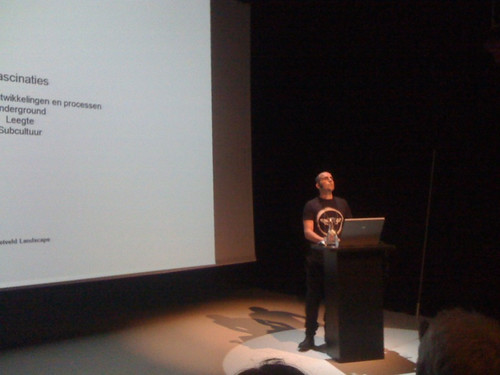
These are the rough notes from the presentation 1:
Going to explain his fascinations by way of his work.
Starts with Amsterdam party scene and scenes from the RoXY. Amsterdam used to be very dynamic in the early 90s.
Fascinated by the underground. Also did an exploration of the meatpacker district of NYC. Holes in the urban fabric allow for dynamism to arise.
Freestate Amsterdam project for the Rotterdam biennale to see about a different way to think about urban planning in the West Port of Amsterdam. It’s a massive port that is mostly unknown and unloved.
The importance of fertile ground for the creative city. In the 80s city center was the freestate of Amsterdam. Roxy became an exponent of the House Revolution and a focal point of the creative industry.
Roxy’s produce:
- Decor
- DJ and VJ as export products
- Graphic design
- Gay-parade/capital
- Amsterdam Dance Event
- Inspiration
His isn’t the city as defined by top down city marketing but by bottom up creation.
After that the IJ shores became the new freestate. With the following progression:
- Old industry
- Emptiness
- Recolonization by festivals
- Metropolitan connection
- Trendies start to arrive (MTV)
- Urbanists and architects arrive
There is now a collective feeling that there isn’t space anymore in Amsterdam to execute creative ideas.
Stubnitz: the boat of the hundred subcultures where different people meet each other (and that has been closed down by the city)
Pluk de Nacht: empty plot of land, 20000 people in 10 days 2
Amsterdam should notice and cherish it’s talent instead of running it out of town.
Shouldn’t a city that wants to become a creative capital have a different approach to city planning?
West port has a bunch of environmental advantages:
- Free sound
- Free height
- No Stadsdeel
- Lots of free space
- High diversity of terrains that are temporarily empty
Houtveemloods near Westerpark Used to be a public swimming area in 1954 Proposals to move abandoned oil rigs from the North Sea to behind westerpark (massively high structures). They are waiting to be repaired in the Waddenzee and costing money.
New Amsterdam Park
Another island was planned near java eiland. A park was necessary.
Focus on different subcultures instead of ethnicity. Shared interests. Try to look for the tension between the subcultures.
Social affordances, the affordances an environment offers for social interaction. (Thesis by his brother.)
Moor a bunch of barges (duwbakken) there with a every barge hosting a different taste/vibe/culture module of the park. Every container is connected with each other. Temporary park.
Another inspiration is: trip through emptiness
Road trip through the flyover states and national parks of the USA
Same phenomena can be applied to the port of Rotterdam. Removed shame green to emphasize the emptiness of the landscape and the activities of the port. Add a flyover highway also to make the port more visible.
Recognize the existing qualities of a place and try to add to those without detrimenting from the original experience.
Asfalt dune where you can drive out onto the sea but in fact do not.
Nice datavisualization of the drive trail of how freely people use the road to go to the Maasmond.
Bunker 599 Cut a bunker in half to make the inside experiencable.
Vacant NL Dutch biennale pavilion
Empty public buildings. Not the empty office buildings. The period between emptiness and repurposing. The time it takes our policy makers to talk about plans. Combined with the knowledge and innovation agenda of the Netherlands to be in the top-5 of the world.
Why these buildings?
- Old stuff inspires new ideas
- Unique affordances for use
- Less rules present
- Affordable space for talent
Show affordances for reusing the empty buildings temporally in a creative economic context. It seems that Groningen is already quite far ahead with this compared to the Rim City area.
Blood sweat and tears to get the entire thing up and running.
There is enough creative potential to fill this up. People move to Berlin because they think there’s space and opportunity there while there could be more than enough of both in the Netherlands.
There’s a ton of architectural experience in the room that is very skeptical of temporary reuse, Dutch civil servants’ risk avoidance and slow moving government processes.
In the Netherlands people start inventarizing what could go wrong and nobody wants to take responsibility.
Update: Streamlined a bit more and added links.